While single-agent reliability is often a prompt engineering challenge, multi-agent reliability is fundamentally an architectural one. In a multi-agent system (MAS), failures frequently emerge not from a single "stupid" LLM response, but from the complex, non-deterministic interactions between autonomous components that were tested in isolation but fail in coordination.
The transition from a single agent to a multi-agent orchestration layer introduces a level of state and permission complexity that most production monitoring isn't designed to catch. These failures are often invisible in demos or happy-path testing, only manifesting when the system encounters the messy, high-concurrency reality of enterprise data and human-in-the-loop dependencies.
The Illusion of Agentic Isolation
The core promise of multi-agent systems is modularity: specialized agents doing specialized tasks. However, this modularity creates a false sense of security. Engineers often assume that because Agent A is scoped to "Research" and Agent B to "Execution," their failure modes are contained.
In production, these boundaries are porous. Information passed between agents carries implicit permissions, state assumptions, and "instruction leakage" that can cause a system to deviate from its intended behavior without ever triggering a traditional exception. If you are building MAS, you are no longer just managing LLM calls; you are managing a distributed system where the "nodes" are probabilistic and the "protocol" is natural language.
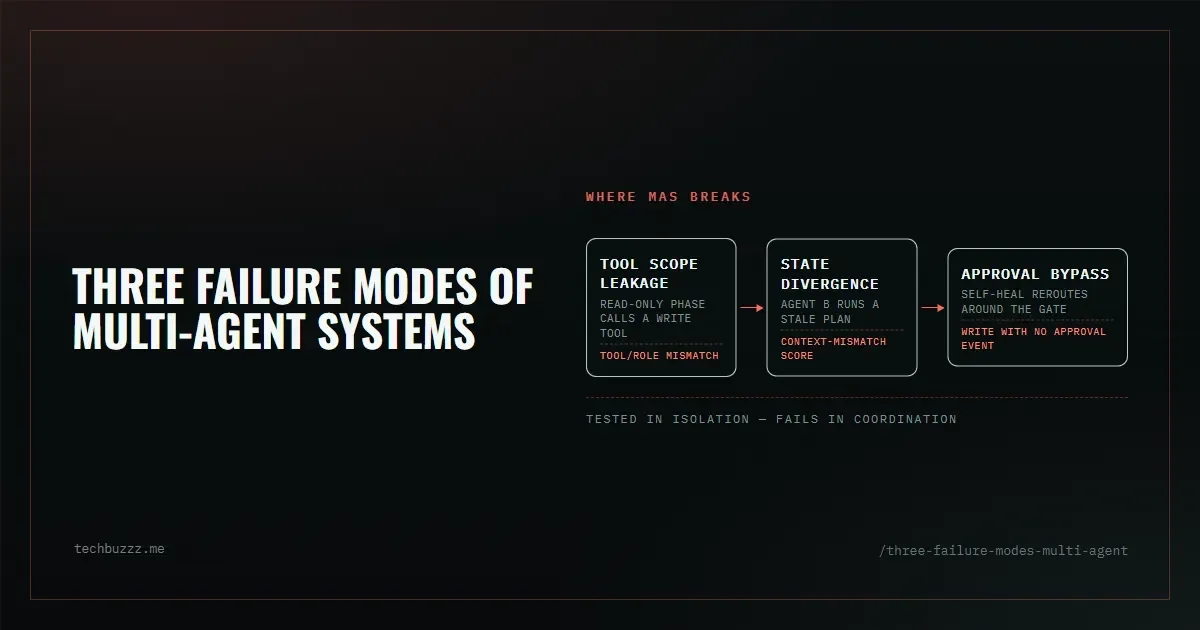
1. Tool Scope Leakage
This occurs when an agent gains access to tools—or the results of tools—that it should not use in a specific task context. In MAS, tool definitions are often shared in a global registry. If the orchestrator doesn't strictly scope the toolset provided to each individual agent for each specific sub-task, an agent may "hallucinate" its way into calling a destructive tool (like delete_record) when it was only supposed to be performing a read operation.
The failure is not that the agent "wanted" to do harm, but that the system design allowed the possibility of the tool being called at that specific state transition.
2. Asynchronous State Divergence
Multi-agent systems often rely on a "Shared Blackboard" or a central state object. When multiple agents operate on this state—especially in parallel or in complex feedback loops—they can begin to work on inconsistent views of the truth.
If Agent A updates the system state with a "Plan," but Agent B begins execution based on a cached, older version of that plan, the system enters a state divergence. Unlike traditional distributed databases, MAS rarely have built-in consensus protocols. The result is a "hallucination loop" where agents try to reconcile the diverging state with more autonomous actions, leading to a cascade of errors.
3. The Invisible Approval Bypass
Human-in-the-loop (HITL) gates are the primary safety mechanism for enterprise agents. However, in multi-agent chains, an approval gate placed at the "wrong" junction can be bypassed by the system’s own internal logic.
If an agent encounters a failure and tries to "self-heal" by routing the task to a different specialized agent, it may inadvertently skip a mandatory approval step that was only attached to the original path. The system achieves the goal, but violates the governance constraint.
Two of these three are not theoretical in our agent work.
Tool scope leakage was the first to surface. Tool definitions lived in a shared registry, so an agent scoped to research could still see write-capable tools — and reach them. The call was never malicious; the design simply made the destructive path reachable from a read-only state.
State divergence followed. One agent published a plan, another picked up an earlier cached version and executed against it. There is no consensus protocol to catch that, and no exception was raised, because from each agent's point of view it was behaving correctly.
The invisible approval bypass has not bitten us in production yet. The mitigation the matrix above recommends, and the one we design toward, is to model approval gates as blocking tasks in the core graph rather than optional nodes — because a gate an agent can route around is not a gate.
Artifact: The MAS Failure Mode Matrix
| Failure Mode | Manifestation | Prevention Strategy | Detection Signal |
|---|---|---|---|
| Tool Scope Leakage | Agent calls db_write during a "Read-Only" research phase |
Dynamic tool injection; per-turn session-scoped tool registries | Tool usage mismatch logs (Tool ID vs. Agent Role) |
| State Divergence | Agent B executes a task based on an outdated plan from Agent A | Immutable state transitions; central orchestrator must "force-sync" context | High "context-mismatch" score in evaluation logs |
| Approval Bypass | System completes a high-stakes action without a human 'OK' | Approval gates as "Blocker Tasks" in the core graph, not optional nodes | Audit trail gaps; successful 'Write' without prior 'Approval' event |
Conclusion — design for the failure, not the demo
The primary lesson from deploying multi-agent systems is that reliability is not a property of the LLM; it is a property of the constraints you place around it. To move from a "cool demo" to a production system, you must stop treating agents as smart colleagues and start treating them as untrusted, probabilistic components in a high-stakes pipeline.
Strict tool scoping, state reconciliation protocols, and non-bypassable approval gates are not "extra" features—they are the minimum requirements for an enterprise MAS architecture.
Related: When Should You Use an AI Agent Instead of a Workflow? | Governed Agentic Workflows: Architecture for Enterprise AI
Sources
- Why Do Multi-Agent LLM Systems Fail? (Cemri et al.) — the MAST taxonomy: three failure classes and 14 modes across 1,600+ annotated traces
Discuss an enterprise AI architecture or delivery challenge → techbuzzz.ru