Enterprise teams are moving from isolated copilots to governed agentic workflows: systems where AI agents can plan, call tools, coordinate with other agents, and complete real business tasks under policy constraints. The promise is obvious. The risk is also obvious. Without architecture, access controls, traceability, and human approval boundaries, an agentic system becomes a fast path to unreviewed actions in production.
This is why the enterprise conversation has shifted from “Can the agent do it?” to “Can the agent do it safely, repeatedly, and with proof?” Governed agentic workflows are the answer. They combine AI governance enterprise practices with an execution model that is observable, testable, and auditable.
What governed agentic workflows actually mean
A governed agentic workflow is not just an AI prompt wrapped around a tool call. It is an orchestrated sequence of steps where each action is constrained by policy, identity, scope, approvals, and logging.
At minimum, a governed workflow includes:
- A task definition with explicit objective and boundaries
- A policy layer that defines which tools and data are allowed
- An agent planner that decomposes work into bounded steps
- A runtime that records every decision and tool invocation
- Approval gates for sensitive actions
- Rollback or compensation logic for failed or risky operations
- Audit outputs that can be reviewed by humans and systems
That combination is what turns a clever demo into an enterprise-grade capability.
Why enterprise systems need governance first
Agentic AI architecture changes the failure mode. Traditional software fails in predictable code paths. Agentic systems can fail through ambiguity, overreach, or hidden tool misuse. An agent may infer a valid-seeming next step that is operationally wrong, expensive, or unauthorized.
Enterprise teams therefore need governance across four dimensions:
- Identity — Which agent is acting, on behalf of whom, and under what role?
- Authority — Which tools, datasets, and systems can the agent touch?
- Traceability — Can every action be reconstructed after the fact?
- Accountability — Who approves, monitors, and owns outcomes?
Without these controls, multi-agent orchestration can create a distributed blast radius. With them, it becomes a managed execution fabric.
Reference architecture for governed agentic workflows
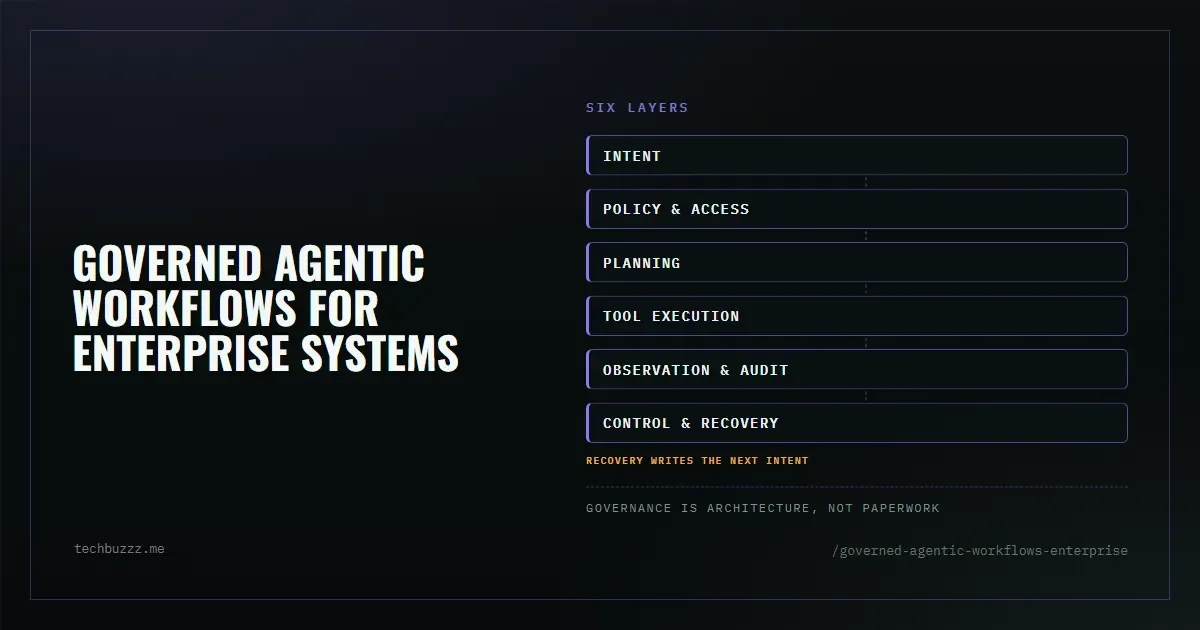
A practical enterprise architecture has six layers.
1) Intent layer
This is where a user or upstream system submits a request in business language. The request should be normalized into a task object that includes:
- business goal
- constraints
- sensitivity classification
- expected output format
- approval requirements
2) Policy and access layer
This layer enforces AI governance enterprise rules before any action is taken. It decides:
- whether the task is permitted
- whether the agent can access a given tool
- whether specific data can be read or written
- whether the action requires a human approval gate
Policies should be machine-readable and versioned. In practice, this means separating policy from prompt text.
3) Planning layer
The planner decomposes the request into steps. Each step should be bounded, typed, and independently reviewable. For example:
- inspect current account status
- draft change proposal
- validate against policy
- request approval
- execute change
- confirm outcome
The key governance principle is simple: planning must not silently imply execution authority.
4) Tool execution layer
This layer handles actual calls to enterprise systems: ticketing, CRM, ERP, databases, document stores, message buses, or internal APIs. Tool execution should be mediated by:
- scoped service credentials
- task-specific permissions
- input validation
- output sanitization
- rate limits and kill switches
If a tool can modify state, it should be treated as a privileged capability.
5) Observation and audit layer
Every step must be logged as an AI agent audit trail. The audit trail should capture:
- task identifier
- actor identity
- policy decision
- prompt or instruction version
- tool name and parameters
- response summaries
- approval timestamps
- final outcome
Good audit logs are not just for compliance. They are how teams debug agent behavior and improve reliability.
6) Control and recovery layer
This is where exceptions are handled. If the agent deviates from policy, times out, or produces low-confidence output, the runtime should:
- pause
- escalate
- request human confirmation
- retry with tighter constraints
- compensate or rollback if needed
A governed system must fail safely, not merely fail visibly.
Where Agent Shaker fits as an illustration
Some teams use orchestration patterns similar to Agent Shaker to prototype delegated tasks and staged approvals. The decision that settled it was moving permissions from the model to the task.
Agent Shaker issues credentials scoped to a single workflow instance: the specific tools that workflow is allowed to call, for the duration of that run, and no longer. There is no standing grant. When the workflow finishes, the access ends with it.
The trade-off is real. Scoped permissions are more work to provision than a model-level role, and they make some legitimate cross-task operations awkward — a task that needs to read something outside its declared boundary has to ask rather than reach. We accepted that. A standing grant is simpler, and simplicity is exactly what makes a capability invisible until something that should not have had it uses it.
The important architectural lesson is not the brand name. It is the design trade-off: more autonomy improves throughput, but every expansion of agent scope requires tighter policy, stronger logging, and clearer approval boundaries.
Approval gates should match risk, not convenience
A common enterprise mistake is to use one approval model for everything. That creates either friction or exposure. Approval gates should vary by risk class.
A useful model is:
- Low risk: agent executes automatically within bounded read-only or reversible actions
- Medium risk: agent prepares the action and requests one approval
- High risk: agent creates a proposal, requires explicit human review, then executes in a controlled window
- Critical risk: agent is not allowed to execute; it can only assist with analysis
This makes the workflow predictable for operators and defensible for governance teams.
Multi-agent orchestration needs role separation
Multi-agent orchestration is powerful when each agent has a clear mandate. Do not give every agent the same permissions. Instead, separate roles such as:
- planner
- researcher
- verifier
- executor
- auditor
That separation reduces the chance that one model both decides and commits a risky action. It also creates cleaner failure containment. If the verifier disagrees, the executor should stop.
Governance checklist artifact
Use this checklist before launching any governed agentic workflow into production:
Governance checklist
- Task objective is explicit and measurable
- Data classification is defined
- Allowed tools are enumerated
- Disallowed tools are explicitly blocked
- Approval thresholds are mapped by risk level
- Human escalation path is documented
- All tool calls are logged
- Prompt, policy, and workflow versions are tracked
- Output is validated before side effects occur
- Rollback or compensation path exists
- Audit review process is assigned
- Access credentials are scoped to the workflow
- Monitoring alerts are configured
- Red-team test cases are completed
- Incident ownership is named
This artifact is intentionally simple. The point is operational consistency, not completeness theater.
Implementation patterns that work
Pattern 1: Make the agent propose, not commit
For sensitive enterprise actions, have the agent generate a proposal that another system or human approves. This is especially useful for finance, procurement, HR, and production operations.
Pattern 2: Bind tools to tasks, not to the model
Do not give a model broad standing access. Instead, issue task-scoped credentials or ephemeral permissions for the specific workflow instance.
Pattern 3: Separate reasoning from execution
The reasoning layer should never be the same component that writes to production. Keep a clean boundary between analysis and actuation.
Pattern 4: Store evidence, not just summaries
Summaries are useful, but enterprises need evidence. Preserve inputs, outputs, policy decisions, and approvals so the AI agent audit trail can support review and incident response.
Pattern 5: Build deterministic guardrails around stochastic components
LLMs are probabilistic. Governance must be deterministic where it matters: access, policy, approvals, logging, and final execution eligibility.
Common failure modes
Even strong teams fall into the same traps:
- Treating prompts as governance
- Allowing hidden tool access
- Logging only final outputs, not intermediate decisions
- Using the same agent for planning and execution
- Skipping approval logic for “internal” workflows
- Assuming retrieval quality equals decision quality
- Forgetting to version policies alongside code
These mistakes are costly because they are often invisible until a serious incident occurs.
How to evaluate maturity
A mature governed agentic workflow should answer these questions clearly:
- Can we show who approved each risky step?
- Can we reproduce the exact path the agent took?
- Can we revoke tool access without rewriting the workflow?
- Can we pause execution when confidence drops?
- Can we explain why a request was blocked?
- Can audit reviewers see the full chain of action?
If the answer to any of these is no, the system is still experimental.
Conclusion
Governed agentic workflows are not about reducing agent capability. They are about making autonomy safe enough for enterprise scale. The goal is not to remove intelligence from the system, but to surround it with control points that preserve trust, compliance, and operational integrity.
If you design the workflow around policy, scoped permissions, auditability, and risk-based approvals, you can deploy agentic AI architecture with confidence. If you skip those layers, you are not building an enterprise system — you are building an uncontrolled experiment.
Sources
- Azure AI Foundry: agents and orchestration — the agent service: model, tools, memory and observability; the baseline for the execution and audit layers
- OWASP Top 10 for LLM Applications — LLM system risks, including agentic scenarios: excessive permissions and uncontrolled tool invocation
- NIST AI Risk Management Framework — govern, map, measure, manage: the risk-management basis for risk-tiered approval gates
- Agent Shaker — AI agent coordination platform: delegated tasks, staged approvals and credentials scoped to a single run