The choice of retrieval unit is the most consequential design decision in a Retrieval-Augmented Generation (RAG) pipeline. Yet, most teams make this decision by default — usually by reaching for a fixed-size character splitter, the tutorial default of 512 or 1,000 characters. While this gets a prototype running in minutes, it often becomes a "silent killer" of production reliability. We treat "chunking" as a simple preprocessing chore, but in reality, it defines the performance ceiling of the entire system. If your retrieval unit is too small, you lose the semantic context necessary for reasoning; if it is too large, you dilute the signal with noise and trigger the "lost in the middle" problem where the LLM ignores the very fact it was supposed to find.
Moving beyond fixed-size chunking isn't just an optimization; it is the transition from a RAG toy to an enterprise-grade AI architecture. It requires a deliberate strategy that matches the "retrieval unit" to the specific geometry of your corpus and the nuance of your users' queries.
The Default Trap: Why Character Chunking Fails
Fixed-size character chunking is popular because it is deterministic and technically agnostic. It doesn't care if you are processing a legal contract, a technical manual, or a Python script. However, this agnosticism is its greatest weakness. By slicing text at arbitrary character counts, you inevitably sever the relationships between subjects and predicates. You split markdown tables in half, isolate citations from the claims they support, and break the logical flow of arguments.
In one RAG pilot for a customs broker, we indexed a moving corpus built from shipping declarations, accompanying transport documents, the full customs-tariff reference (HS / TN VED codes), every applicable regulation, and years of internal case files for similar products. A user did not "ask" anything: a declaration arrived, the system had to analyse it, join it against the existing graph of precedents and internal rulings, and produce an aggregated verdict. The retrieval unit was large (well over eight wide chunks per document), and every chunk had to be re-embedded every night because TN VED codes, regulations, and internal rulings updated daily. That nightly refresh window was the first place where the choice of retrieval unit started to hurt us: when a regulatory paragraph was split across two flat-chunks, the legal reference in one chunk and the exception clause in the next behaved like independent facts. The retriever returned a high-confidence hit that satisfied the scoring metric; the LLM stitched the two halves into a single, confident sentence that contradicted the intent of the original regulation. The original violation pattern only surfaced when a human reviewer walked back through the cited chunks and saw that the "exception" lived one cut-line away from the "rule." We replaced the flat splitter with layout-aware, section-anchored chunking the same week — not because it improved Recall@K, but because it eliminated the class of cuts that put semantically dependent clauses on opposite sides of a boundary.
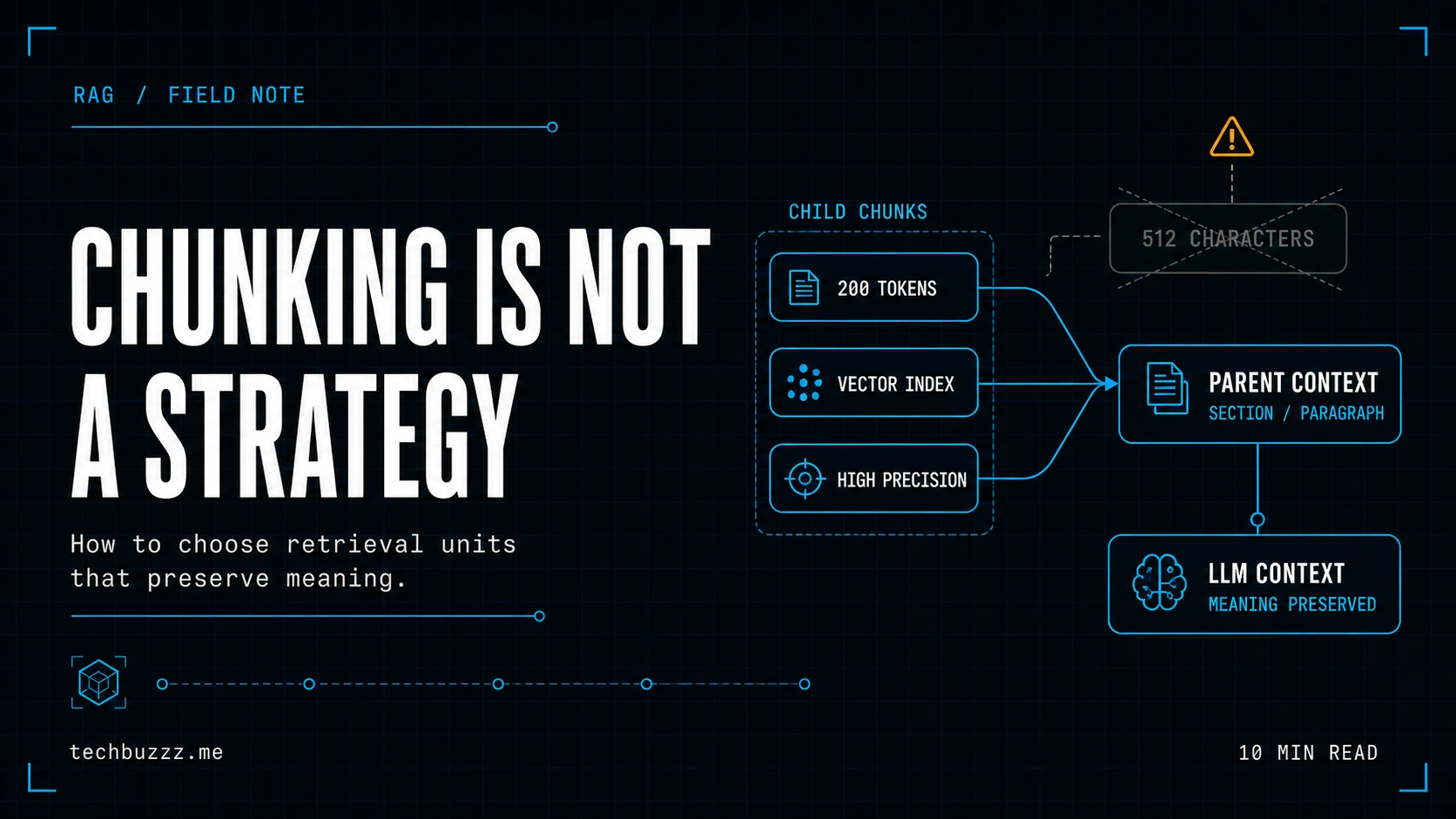
When a chunking strategy ignores the structure of the document, the vector database becomes a graveyard of "shards" — meaningless snippets of text that look relevant to a search algorithm but lack the internal coherence for an LLM to generate a sensible answer. This is why character-based splitting should be viewed as a baseline, not a strategy.
Precision vs. Recall: The Granularity Trade-off
Every RAG architect faces a fundamental trade-off between precision and recall, governed by the size of the retrieval unit.
- Small Units (Sentences): These offer maximum precision. If your query is a specific factoid ("What is the capital of France?"), a single sentence provides the exact answer without noise. However, recall is poor. Most enterprise "Why" or "How" questions require context spanning multiple sentences.
- Large Units (Full Documents or Sections): These offer maximum recall. You are guaranteed to include the relevant facts. But precision is miserable. The LLM is forced to process hundreds of tokens of irrelevant "filler," increasing latency, cost, and the risk of hallucinations.
The goal is to find the "Goldilocks" unit — one that captures enough context to be meaningful but remains focused enough to be precise.
Architectural Patterns: Beyond the Single Chunk
To solve the granularity trade-off, sophisticated RAG pipelines move toward decoupled retrieval. Instead of seeking a single "perfect" chunk, we use architectures that treat the indexed unit and the retrieval unit differently.
Parent-Child Retrieval: This is perhaps the most effective pattern for complex corpora. You split your documents into small, granular "child" chunks (e.g., 200 characters) for the purpose of vector indexing. This keeps the embeddings very "pure" and focused on specific topics. However, when a child chunk is retrieved, the system fetches its larger "parent" context (e.g., the surrounding paragraph or section) to pass to the LLM. This gives you the precision of a small unit for search and the recall of a large unit for generation.
Hierarchical Chunking: This involves creating a tree structure of your content. You index summaries of sections, then summaries of paragraphs, and finally the raw text. The search algorithm can then "zoom in" from the high-level summary to the specific detail, navigating the document like a map rather than a linear list of strings.
The "Lost in the Middle" Constraint
Even with perfect retrieval, the size of your unit is constrained by the LLM's attention mechanism. Research has consistently shown that LLMs suffer from the "lost in the middle" phenomenon: they are best at utilizing information located at the very beginning or end of their input context.
If your retrieval units are large (e.g., retrieving five 2,000-token sections), the relevant facts are likely to get buried in the middle of a 10,000-token prompt. In this scenario, the model's performance on reasoning tasks drops significantly. High-performance RAG requires retrieval units that are dense. Every token in the retrieved context should either be the answer or the context strictly necessary to understand the answer.
Artifact: The Retrieval Unit Decision Table
Choosing the right unit depends on your data and your users. Use this table to align your strategy with your corpus characteristics.
| Retrieval Unit | Primary Strength | Ideal Corpus | Query Type | Structural Regularity |
|---|---|---|---|---|
| Sentence | Precision | Highly dense facts | Fact-seeking | Very High (Legal/Code) |
| Paragraph | Coherence | General prose | Explanatory | Medium |
| Semantic Chunk | Contextual Unity | Unstructured logs | Multi-hop | Low (Transcripts) |
| Section | Theme / Recall | Manuals, Reports | Summarization | High |
| Full Document | Total Recall | Short memos / emails | Comparison | N/A |
Choosing Your Path
- If your document has a clear hierarchy (H1, H2 tags), use Sectional Chunking.
- If your documents are long and unstructured, use Semantic Chunking (using an LLM or embedding model to detect topic shifts).
- If you need to answer granular questions about specific data points, use Parent-Child Retrieval.
Summary
Chunking is not just a technical step; it is the physical design of your AI's "memory." By moving beyond the tutorial defaults of character splitting, teams can significantly improve the reasoning capabilities of their RAG systems while reducing the noise that leads to failure.
Related Articles:
- 5 Questions Before Starting a RAG PoC
- A Practical Reference Architecture for Enterprise RAG on .NET and Azure
- RAG Is a System, Not a Prompt
Discuss an enterprise AI architecture or delivery challenge → techbuzzz.me