The initial high of building a Retrieval-Augmented Generation (RAG) prototype is intoxicating. You point an LLM at a folder of PDFs, spin up a vector database, and suddenly, the machine is answering questions about your enterprise data with startling clarity. But then, the weekend passes. You show it to a stakeholder, and it misses a crucial clause in a contract. You try to scale it to the full document repository, and the cost triples while accuracy plummets.
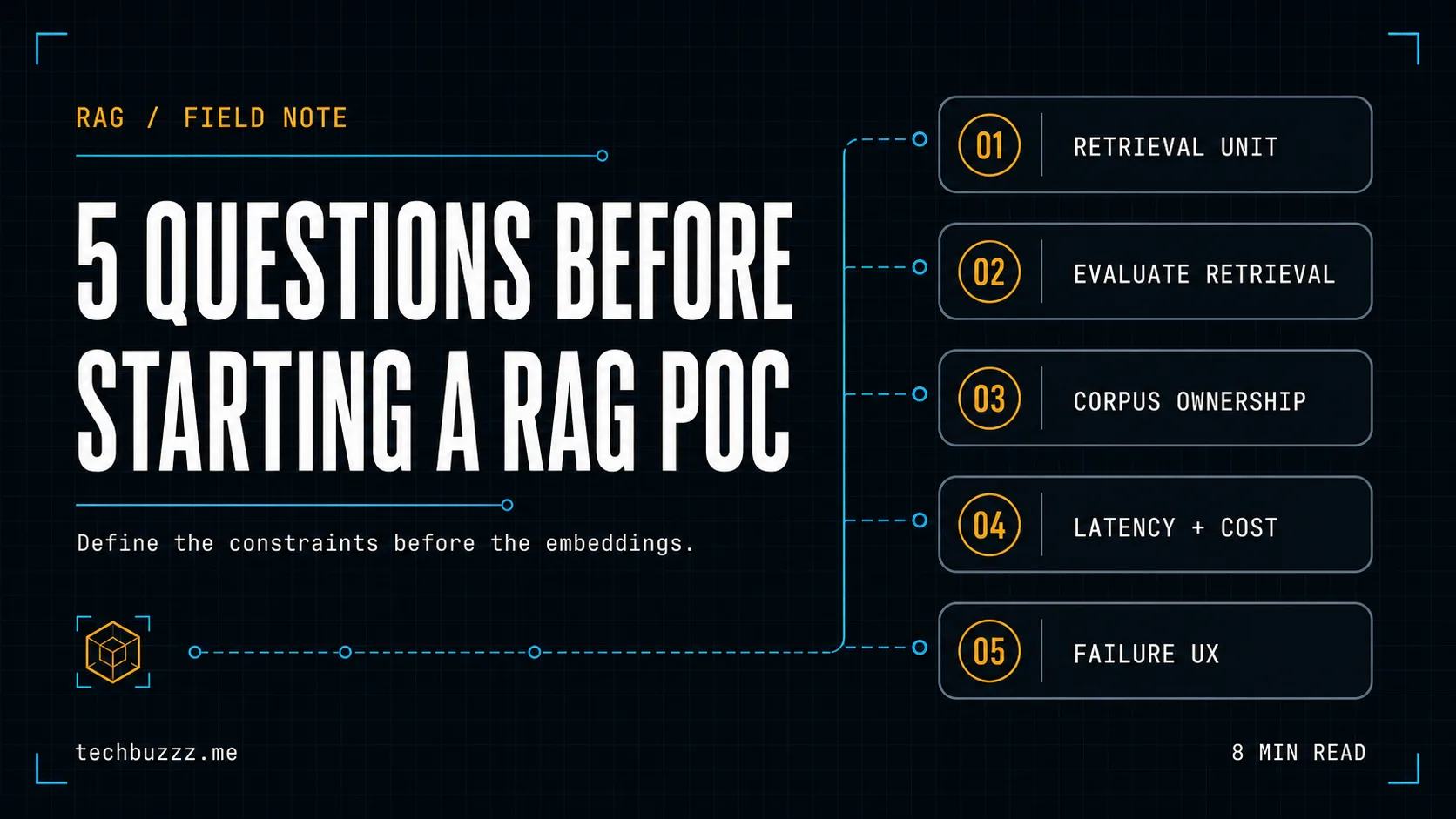
Most RAG Proofs of Concept (PoCs) fail not because the technology is fundamentally flawed, but because the foundational architecture was built on unexamined assumptions. We tend to jump into embedding models and vector similarity scores before defining the business and technical constraints that actually dictate success. In my experience, the difference between a prototype and a production-ready system lies in five specific questions. These questions should be answered before a single line of orchestration code is written, as each one pivots every design decision that follows.
1. What is the fundamental Retrieval Unit?
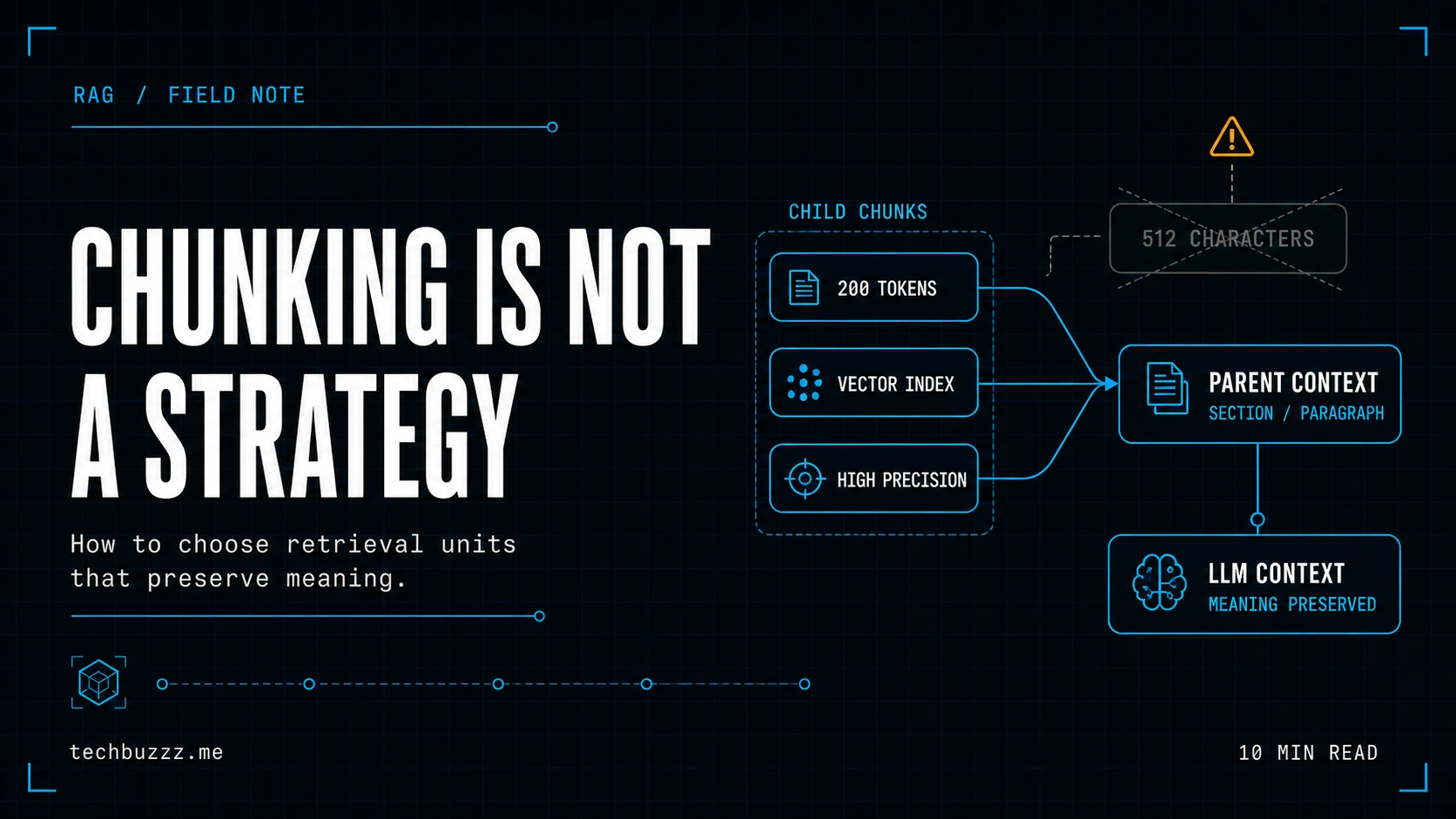
The most common mistake in RAG PoC planning is treating "chunking" as a purely mathematical problem — splitting text every 512 tokens with a 10% overlap. This ignores the semantic structure of your data. A "retrieval unit" is the smallest discrete piece of information that can meaningfully answer a query.
If you are building a RAG system for legal contracts, is the unit a paragraph, a section, or the entire document summary? If it's for technical manuals, does a chunk need to include the preceding heading and a table of contents path to be useful? Defining the retrieval unit early dictates your embedding strategy, your metadata schema, and whether you need complex techniques like "parent-document retrieval" or "recursive character splitting." Without a clear unit, your model will suffer from "lost in the middle" problems or retrieve context that is semantically relevant but structurally useless.
2. How will we evaluate retrieval before generation?
We often judge RAG systems by the final prose the LLM produces. This is a trap. If the LLM produces a hallucination, you have two possible culprits: a failure of retrieval (the right info wasn't found) or a failure of generation (the info was found, but the model hallucinated anyway).
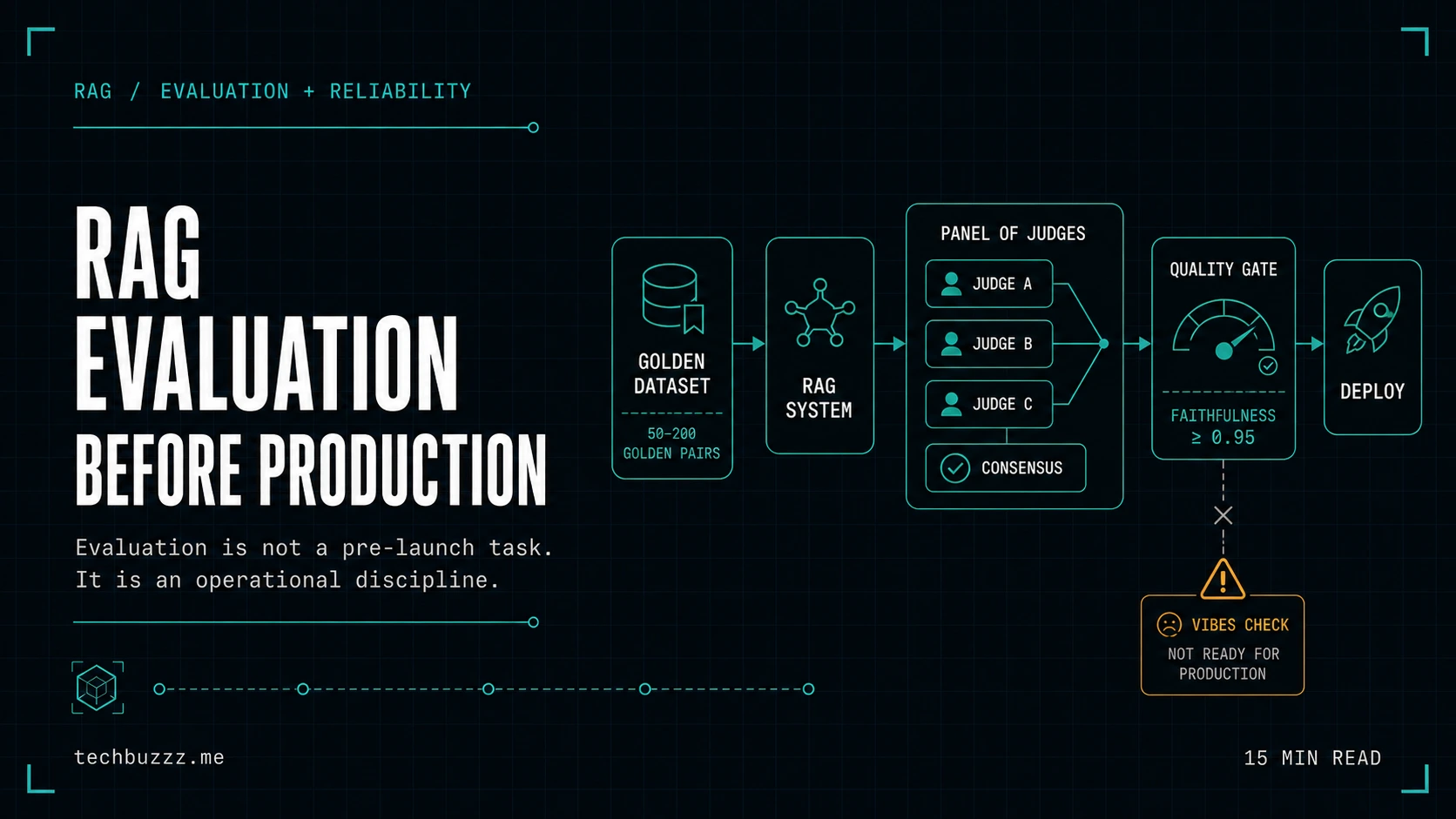
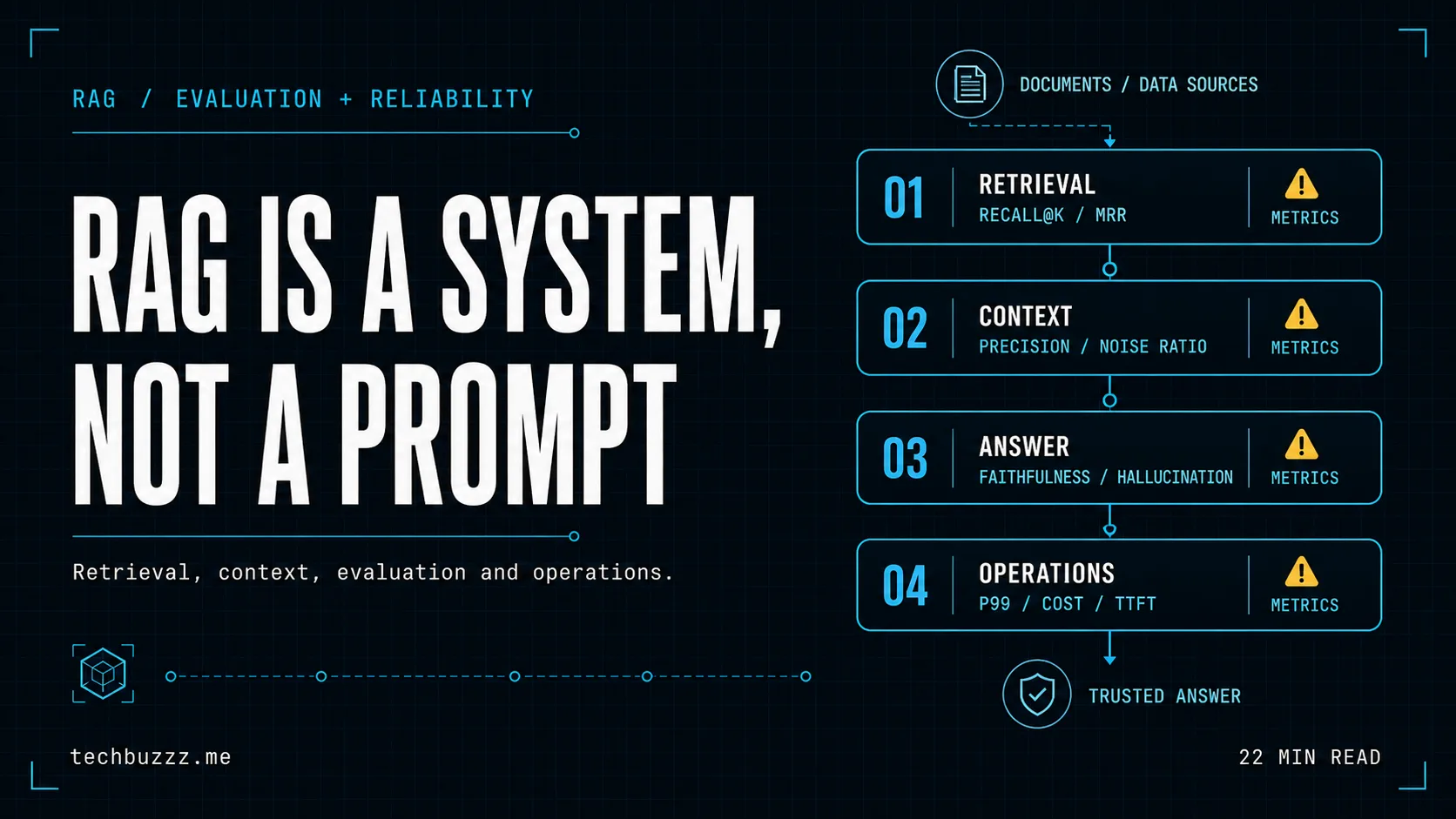
Before you even hook up a generation model, you must measure your retrieval pipeline. This means establishing a "Golden Dataset" of query-document pairs and measuring metrics like Recall@K (did the right document appear in the top K results?) and MRR (Mean Reciprocal Rank). Production-grade RAG requires knowing that your retrieval system is "Recall-complete" before you start tweaking prompt templates. If you skip this, you'll find yourself wasting weeks on prompt engineering to fix a problem that is actually living in your vector database.
3. Who owns the corpus, and how often does it change?
A RAG system is only as good as the data it accesses. In many enterprise environments, the "corpus" is a moving target. Files are updated daily, permissions change, and documents are archived.
You must define the synchronization lifecycle. Is this a one-time ingestion, or does the vector store need to reflect changes in real-time? Furthermore, "Corpus Ownership" involves data hygiene. If your source of truth is a messy SharePoint drive full of v2_FINAL_FINAL.pdf files, your RAG system will inherit that mess. Establishing who is responsible for the source data quality and the pipeline that refreshes the index is a prerequisite for reliability.
4. What is the acceptable latency and cost per query?
The "R" in RAG is expensive. Every query involves:
- Embedding the user query.
- A similarity search in the vector database.
- Ranking/reranking the results.
- Sending the context and query to the LLM.
In production, these steps add up. If your users expect sub-second responses, but your reranker takes 800ms and your LLM takes 2 seconds to stream a response, your PoC will fail the user experience test. Costs also scale linearly with volume — not just LLM tokens, but the infrastructure costs of high-performance vector search and embedding inference. Answering the "cost-per-query" question early allows you to decide if you need a smaller, faster model (like an 8B param local LLM) or if you can afford the luxury of a multi-stage GPT-4o pipeline.
5. What is the Failure UX?
The final question is perhaps the most critical: what does the application do when it can't find the answer? Relying on the LLM to say "I don't know" is insufficient, as LLMs are trained to be helpful and often prefer a confident lie over a silent failure.
Designing the "Failure UX" means defining thresholds for retrieval scores. If the highest similarity score in your database is below a certain epsilon, the system should perhaps skip the LLM call entirely and trigger a fallback mechanism — be it a human-in-the-loop, a standard search, or a "no information found" UI state. By planning for failure, you build trust with the end-user, proving that the system knows its own boundaries.
Artifact: The RAG PoC Readiness Checklist
| Question | Why it Matters | What a Good Answer Looks Like | Impact of Skipping |
|---|---|---|---|
| Retrieval Unit | Determines embedding strategy and metadata. | "A single clause in a contract, including its parent header and document ID." | Poor context quality; model gets fragments instead of facts. |
| Eval (Pre-gen) | Identifies if retrieval or generation is the bottleneck. | "A 100-query benchmark achieving >0.8 Recall@5 before testing LLM outputs." | Wasted weeks on prompt engineering when the data was never retrieved. |
| Corpus Change | Ensures consistency with the source of truth. | "Daily sync from S3; source owners must approve document metadata tags." | Data drift; users get outdated or conflicting information. |
| Latency/Cost | Sets realistic expectations for production scaling. | "Max 2.5s end-to-end; <$0.05 per query at 1,000 queries/day." | Project gets killed late-stage due to excessive cloud bills or slow UI. |
| Failure UX | Prevents hallucinations and builds user trust. | "For similarity scores <0.7, show 'Direct Source Not Found' and offer manual search." | Confidence loss due to high-stakes hallucinations or "helpful" lies. |
Related Articles:
- From AI Demos to Governed Production Systems
- Why "an LLM chatbot" is not an AI architecture
- A Practical Reference Architecture for Enterprise RAG on .NET and Azure
Discuss an enterprise AI architecture or delivery challenge → techbuzzz.me