The transition from Senior Engineer to Principal Engineer is often described as a promotion, but that label is fundamentally misleading. In the traditional corporate ladder, we assume that each step up is simply a more intense version of the previous one. A Junior becomes a Mid-level by needing less supervision; a Mid-level becomes a Senior by leading projects and mastering their tools. But the jump from Senior to Principal? That is not a linear climb. It is a career pivot.
You feel it first as a subtle, persistent tension. You are the top performer in your squad. You have mastered the stack, you lead the most complex migrations, and you are the one called upon when the production environment is melting down. You've reached the point where you can solve almost any technical problem thrown at you. Yet, as you look toward the next level, the path feels obscured. You might think the answer is simply "more" — more code, more complexity, more hours. But doubling down on what made you a great Senior Engineer — individual technical excellence and high-velocity delivery — is actually the quickest way to plateau.
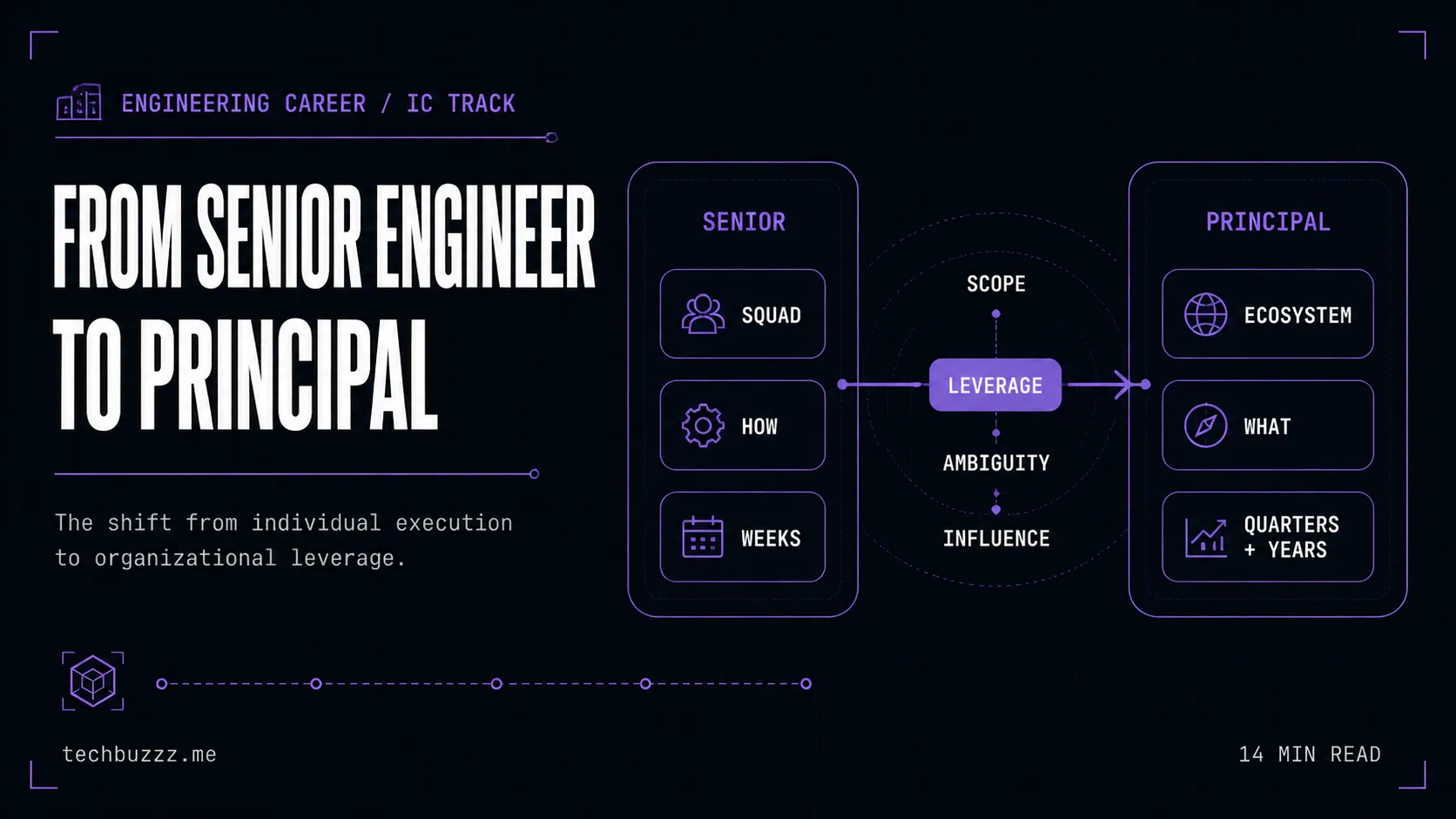
The Claim: The transition to Principal is not about becoming a "Senior++." It is a fundamental shift from individual execution to organizational leverage. You move from being the person who solves the hardest problems to the person who ensures the most important problems are being solved by the right people, with the right architecture, at the right time. It is a transition from being a "Force of Nature" to being a "Force Multiplier."
1. The Expansion of Impact Radius: From Squad to Ecosystem
As a Senior Engineer, your impact is generally measured by the success of your immediate team or squad. You are responsible for the quality of the codebase you touch and the delivery of the features assigned to your orbit. When you do your job well, the team ships on time, the code is maintainable, and technical debt is managed. Your radius is narrow but deep. You are the anchor of your team.
When you step into a Principal role, that radius expands significantly. You are no longer tethered to a single backlog or a single set of KPIs. Your "accountability" shifts from a specific set of features to the health, scalability, and technical integrity of an entire department, platform, or organization.
This expansion is often uncomfortable because it requires a shift from visible to invisible impact. At the Senior level, success is tangible; you can point to a merged Pull Request, a resolved bug, or a successfully shipped feature. As a Principal, your greatest contributions may never appear in a sprint report.
Consider the "Invisible Impact" of a Principal Engineer:
- The Architectural Disaster Prevented: Steering a team away from a "trendy" but unsuitable technology that would have led to a six-month rewrite two years down the line.
- The Alignment Conversation: A 20-minute discussion between two product teams that identifies a redundant service being built, saving hundreds of engineering hours.
- The Cultural Shift: Standardizing a process for RFCs (Requests for Comments) that elevates the technical discourse across the entire company.
You are operating at the level of systems — both technical and human. You are looking for the "leverage points" where a small amount of effort can yield a massive result for the organization.
2. The Source of Problems: From "How" to "What"
The most profound change lies in where your work comes from. A Senior Engineer is a master of the "How." Give them a problem, a set of constraints, and a deadline, and they will produce an elegant, robust solution. They internalize the product requirements and translate them into code. The source of their problems is most often external: a Product Manager, a roadmap, or a bug report. In this mode, you are a world-class reactive solver.
In contrast, a Principal Engineer must become a master of the "What." You are expected to identify and define problems that don't yet have a name and haven't appeared on any roadmap. You look at the intersection of technical debt, business strategy, and team velocity to find the hidden friction.
For example, a Senior Engineer might focus on optimizing a slow database query. A Principal Engineer asks why the data model is growing at a rate that makes that query slow in the first place, and whether the business is storing data it doesn't actually need. They might identify that the company's lack of a unified data strategy is the root cause of dozens of performance issues across multiple teams.
This shift requires an intense level of business acumen. You cannot decide "what" the organization should work on if you don't understand how the company makes money and where the market is moving. You stop being a "tech person" who receives requirements and start being a "business partner" who uses technology to solve organizational challenges.
3. Ambiguity, Time Horizons, and Influence
The higher you climb the individual contributor (IC) ladder, the more ambiguity you are expected to consume. Senior-level tasks usually have a relatively clear time horizon — typically weeks or months. Success is binary: either the service is refactored or it isn't.
Principal-level initiatives often span quarters or even years. You are thinking about the "North Star" architecture — where the system needs to be in 24 months to support 10x growth. You are dealing with problems that have no "correct" answer, only a series of trade-offs where every path has a significant cost. You must be comfortable making high-stakes decisions with only 60% of the information available.
Additionally, you shift from leading by expertise to leading by influence. As a Senior, people listen because you are the best coder. As a Principal, you rely on Social Capital. This is the trust you have built across the organization. It is your ability to listen, synthesize disparate viewpoints, and guide a group toward consensus without pulling rank. Principal engineers are the "glue" that holds different parts of the organization together. They translate technical constraints to executives and business goals to engineers. If you cannot influence people over whom you have no direct authority, you will struggle to succeed at this level.
4. Senior vs. Principal Scope: A Dimensional Comparison
To visualize this shift, we can look at the transition across six key dimensions that define an engineer's professional footprint.
| Dimension | Senior Engineer | Principal Engineer |
|---|---|---|
| Technical Depth | Mastery of specific stacks, languages, and local implementations. | Strategic depth; mastery of system-wide trade-offs and patterns. |
| Problem Source | Assigned by product, leadership, or the team roadmap. | Self-directed; identified via systemic analysis of the business and tech. |
| Impact Radius | The Squad or immediate Team; focused on local delivery. | The Department, Platform, or Org; focused on global optimization. |
| Time Horizon | Weeks to a Quarter; tactical execution of the current plan. | Quarters to Years; strategic planning for the "North Star." |
| Ambiguity Tolerance | Low to Medium; requires defined requirements to be effective. | Very High; expected to define the requirements and scope for others. |
| Success Metric | Feature delivery, code quality, team-level velocity. | Org-wide scalability, architectural integrity, net-positive ROI of tech. |
5. The Daily Reality of the Role
Transitioning into a Principal role is not just a change in title; it's a radical change in how you spend your energy and what you prioritize in your day-to-day work.
In my transition, I had to confront three harsh realities:
- Stop being the First Responder. At the Senior level, part of your identity is tied to being the "technical hero" who fixes the breaking build at midnight. As a Principal, you must let go of that. If you are the only one who can solve a problem, you have created a bottleneck. I had to learn to step back and let teams struggle — and sometimes fail — so they could build the muscle memory to solve those problems themselves.
- Start the "Boring" Work. My days shifted from high-flow coding to meetings, RFC reviews, and long-form strategy documents. I found it deeply uncomfortable at first. I felt like I was "wasting time." It took me a year to realize that a single strategy document that prevents three teams from building incompatible APIs is worth more to the company than any amount of perfectly refactored code.
- The Loss of "Flow." As a Senior, your best days are 6 hours of uninterrupted concentration. As a Principal, your day is fragmented by design. You are the "context switcher in chief." Learning to provide high value in small, fragmented bursts — shifting from budgeting to architectural review to vendor research — is a specific skill that is incredibly difficult to master.
6. Practical Self-Assessment: Are You Ready?
If you are a Senior Engineer eyeing the Principal level, ask yourself these seven questions. This isn't about your ability to optimize an algorithm; it's about your readiness for a different category of impact.
- Can you let go of the "Hero" mindset? Are you genuinely okay with someone else getting the credit for a project's success because you spent your time coaching them and removing their blockers behind the scenes?
- Do you look for "Why" before "How"? When a new initiative is proposed, is your first instinct to think about the database schema, or do you first question how this fits into the company's long-term competitive advantage?
- How do you handle "Political" engineering? Can you navigate a situation where two leads have diametrically opposed technical visions, and guide them to a compromise that serves the business?
- Is your code a tool or a craft? Can you pragmatically accept "good enough" code to meet a critical market window, while ensuring you have a concrete plan to address the debt later?
- Do you enjoy writing for humans? At the Principal level, your primary interface is the written word. If writing an 8-page white paper on why the company should move to a mono-repo sounds like torture, the role will frustrate you.
- Can you identify a problem 6 months before it hits the surface? Are you proactively scanning for "architectural rot," or are you waiting for the SRE team to start paging you?
- Are you okay with being "unproductive" by old standards? Can you look back at a week with no commits and feel successful because you aligned three departments on a shared security standard?
Conclusion
The jump to Principal Engineer is the hardest transition in the IC track because it requires unlearning the habits that made you successful as a Senior. It is no longer about your brilliance; it is about the collective brilliance you can enable. You stop being the star player and start becoming the coach who designs the playbook. If you can find satisfaction in the success of the system rather than the success of the PR, you are ready for the pivot.